
A sarcophagus for three. The tragic story of a late antique senatorial family revealed by two grave inscriptions from Salona

by Nathalie Marie Kettner (Freie Universität Berlin) and Chiara Cenati
For people living in antiquity death was omnipresent and could even affect those from a high social rank early and unexpectedly. The risk of dying at a young age was particularly high for women in labour and for little children. An inscription from the MAPPOLA database tells such an unfortunate story and provides insight into the life and death of a late antique senatorial family.
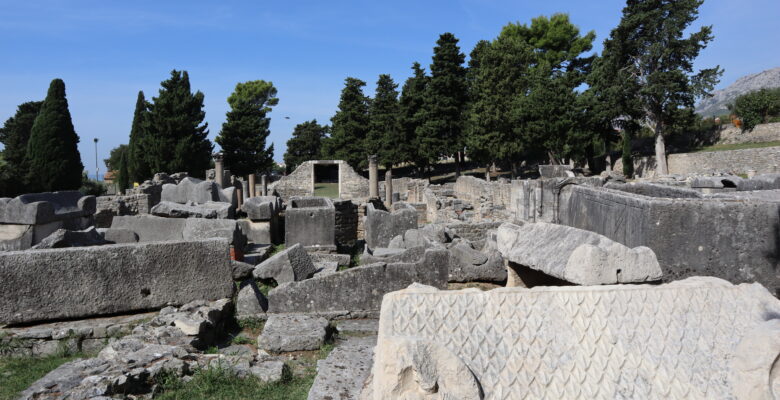
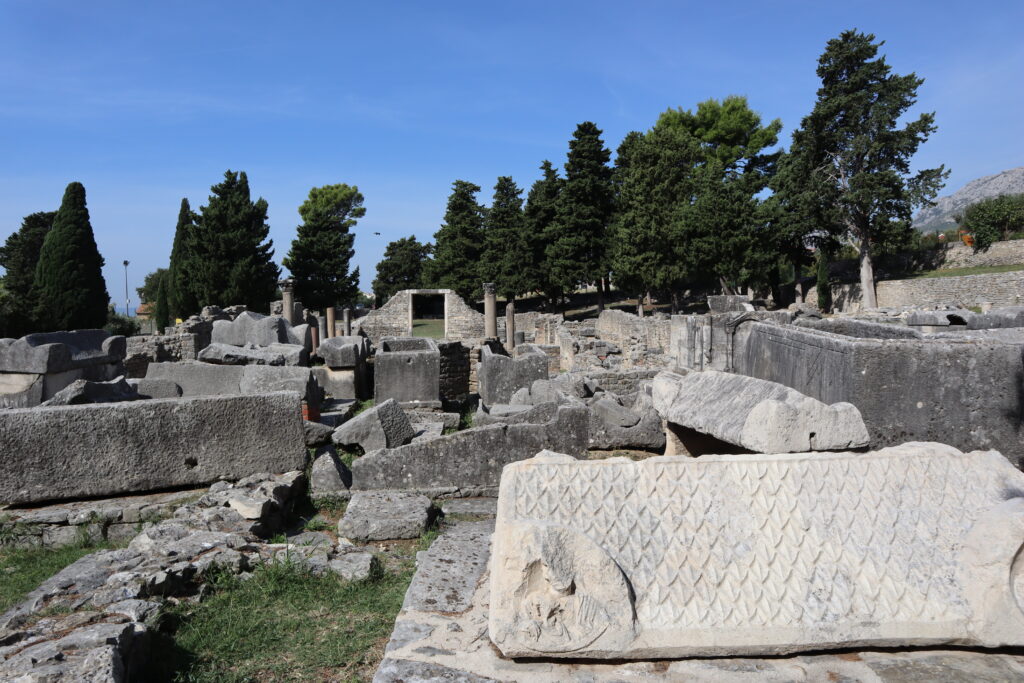
In the year 1884 a sarcophagus bearing two grave inscriptions was discovered at Manastirine, one of the major late antique cemeteries of the ancient city of Salona (modern Solin in Croatia). The sarcophagus was originally placed in a building known as Chapel VII or Mausoleum VII, where you can still see it today. It is made of limestone and bears no decoration except from an epigraphic field framed by two chiselled lines. Inside of the epigraphic field we can see an inscription consisting of 8 lines written in verses (dactylic hexameters) and one additional line written in prose. Shortly after inscribing the first inscription, another text was carved into the surface of the sarcophagus to the left of the epigraphic field.
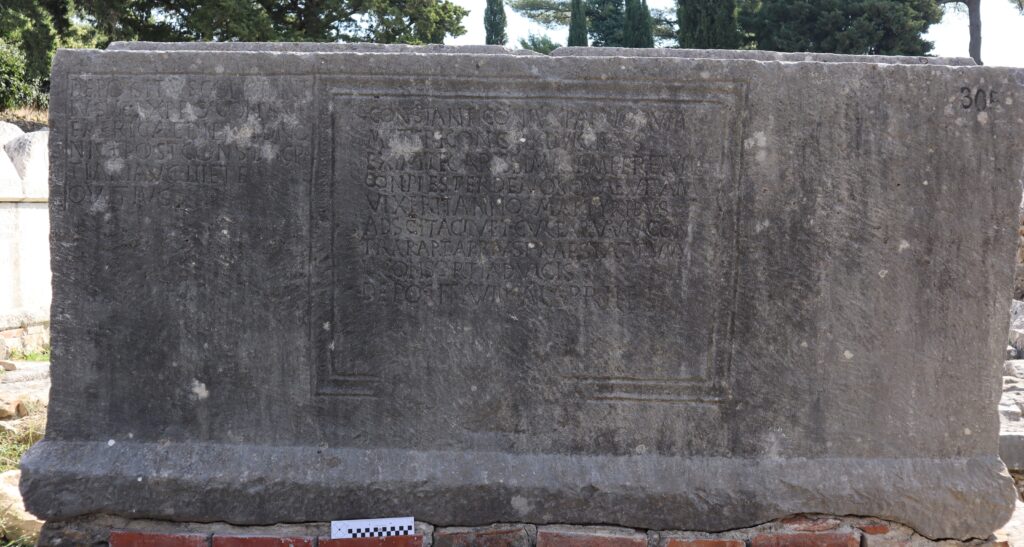
This is the inscription in the epigraphic field:
Constanti coniu(n)x parvorum
mater Honoria dulcibus
eximie carissima semper et una
co⸢m⸣ple(n)s ter denos quae vitam
vixerit annos martyribus
adscita cluet cui parvula con-
tra rapta prius praestat tumu-
li consortia dulcis.
Deposita VII Kal(endas) Apriles.
(CIL III 9506 = CLE 666 = ILCV 78 = ILS 1287 = ILJug III 2388 = Marin et al., Salona, 401–404 Nr. 159 = MPL00457 = MQDQ = https://lupa.at/24467 = HD034773)
“The wife of Constantius, a mother of little children, Honoria was exceptionally dear to her loved ones, always, the only one. She lived a life completing three times ten years, praised as she is included in the ranks of the martyrs. Facing her, a little girl, snatched away earlier, sweetly keeps her company in the tomb. She was buried on the seventh day before the Kalendae of April (=26 March).”
The metrical inscription within the epigraphic field was made for a woman called Honoria. She was married to an honourable man named Paulus Constantius, who belonged to the highest class of Roman society. As we know from the inscription the couple had several children. Tragically, Honoria died at the age of thirty years and was buried inside of the sarcophagus together with her little girl. The inscription says that mother and child now keep each other sweet company inside of their tomb. Maybe, both of them had died during childbirth. However, they may also have died from an infectious disease.
The epitaph expresses that Honoria was very dear to her family and that she was included in the ranks of the martyrs after her death (martyribus adscita). By mentioning the martyrs, the inscription refers to Honorias’ burial place. The mausoleum, in which her sarcophagus was placed, was located next to the graves of the local bishops and of a martyr named Domnio, a bishop of Salona who was killed during the persecution of Christians under emperor Diocletian. These men were highly venerated by the population of Salona during the 4th century AD. The area around their tombs was probably crowded with many sarcophagi of people who wished to be buried there, near the saints (ad sanctos).
As already mentioned, another inscription was carved into the surface of the sarcophagus:
Depositus Constant-
ius v(ir) c(larissimus) ex proconsul-
e A⸢f⸣ricae die prid(ie) No-
n(as) Iul(ias) post cons(ulatum) d(omini) n(ostri) Gra-
tiani Aug(usti) III et E-
quiti v(iri) c(larissimi).
“Constantius, a man of senatorial rank, former proconsul of Africa, was buried (here) on the day before the nones of July (in the year) after the consulate of our lord (emperor) Gratianus Augustus for the third time and of Equitius, the man of senatorial rank.”
Honoria’s husband Paulus Constantius is not only known through this grave inscription from Salona, but also through several inscriptions from northern Africa. According to the Codex Theodosianus, a collection of late antique imperial constitutions, he was appointed governor of the Roman province Africa (proconsul Africae) in 374 AD. As we know from the epigraphic sources Paulus Constantius was accompanied to Africa by his sons. The first son was called Antonius Paulus. The full name of the second son, Paulinus, is not known to us. Both sons assisted their father as legates during his governorship. As they held positions in the Roman administration, they were already adults at this time. Therefore, we can not consider Honoria as their mother. Antonius Paulus and his brother must have been born from an earlier marriage of Paulus Constantius, on which we have no information.
According to the inscription on the left part of the sarcophagus, Paulus Constantius was buried on the 6th of July 375 AD at Salona, which means that he died shortly after the end of his governorship.
History’s Blind Spots: The Story of Constantius and Honoria
As historians, we constantly encounter blind spots in our attempts to narrate the past. The case of Paulus Constantius and Honoria is one such puzzle – full of unanswered questions about the final months of their lives, and about the choice of Salona as their final resting place.
The closing chapter of Constantius’ life was dense with events: his prestigious governorship of Africa, the conclusion of his mandate, a long journey to Dalmatia, and finally his death, recorded on 6 July 375. But did his wife Honoria also die during this period?
Her inscription gives us only a date – the 26th of March – but no year. We do know she died before Constantius, as his inscription was carved later, added onto the same sarcophagus. So Honoria’s death must have occurred in 375 or earlier.
After finishing his duties in Africa, did Constantius travel directly to Salona? Did he make the journey alone, or did the entire family return together? Was the trip made in haste – perhaps because his wife was pregnant or unwell? Or if Honoria had not accompanied him to Africa, did Constantius arrive in time to see her one last time? Did he meet the little girl mentioned in her inscription?
And then there is the question of Salona. Why were Honoria, Constantius and their little daughter buried there? Was Salona Constantius’ hometown? Or did Honoria’s family come from the city? There is no firm evidence of either.
This is where history fades into several possibilities. There are countless versions of this story – many plausible, none confirmed. Which one do you imagine?
Ready?
Choose your favorite timeline and tell us your version of the story of Constantius and Honoria.
Share your version of the story in the comments – or send it to us: mappola@erc.eu
Some bibliographical references
Yasin, A. M. (2012). Reassessing Salona’s Churches: Martyrium Evolution in Question, Journal of Early Christian Studies 20, 59–112.
Pallu de Lessert, A. C. (1901), Fastes Provinces africaines sous la domination romaine (Paris).
Marin e. a. (ed.) (2010). Salona IV: Inscriptions de Salone chrétienne, IVe-VIIe siècles (Rome) 401–404 Nr. 159.
Egger R. (1926). Der altchristliche Friedhof von Manastirine, Forschungen in Salona II (Wien).
Sanader, M. (2009). Dalmatia. Eine römische Provinz an der Adria (Mainz).